
Dutch Housing Market 2026: Should You Buy Now? Rates, Prices and Best Segments Explained
A data-driven guide for buyers in the Netherlands: mortgage rates, price trends, and where you actually have negotiating power today.
Expectation vs Reality
A year ago, the outlook for the Dutch housing market seemed straightforward.
The European Central Bank was expected to continue cutting rates, mortgage costs were forecast to fall, and major banks — Rabobank, ABN AMRO, ING — projected house price growth of around 5–8% for 2025. The logic was simple: cheaper borrowing would unlock demand, while a structural housing shortage would keep prices rising.
What actually happened was more nuanced.
Prices did rise in 2025 — by roughly 8.5% nationally. But by Q1 2026, momentum slowed sharply: around +2.1% year-on-year and negative quarter-on-quarter. Forecasts for 2026 have already been revised down. Mortgage rates stopped falling, and a wave of former rental properties entered the market in major cities.
The market did not reverse — but the drivers of growth became narrower and more segmented.
Mortgage Rates: What Matters Right Now
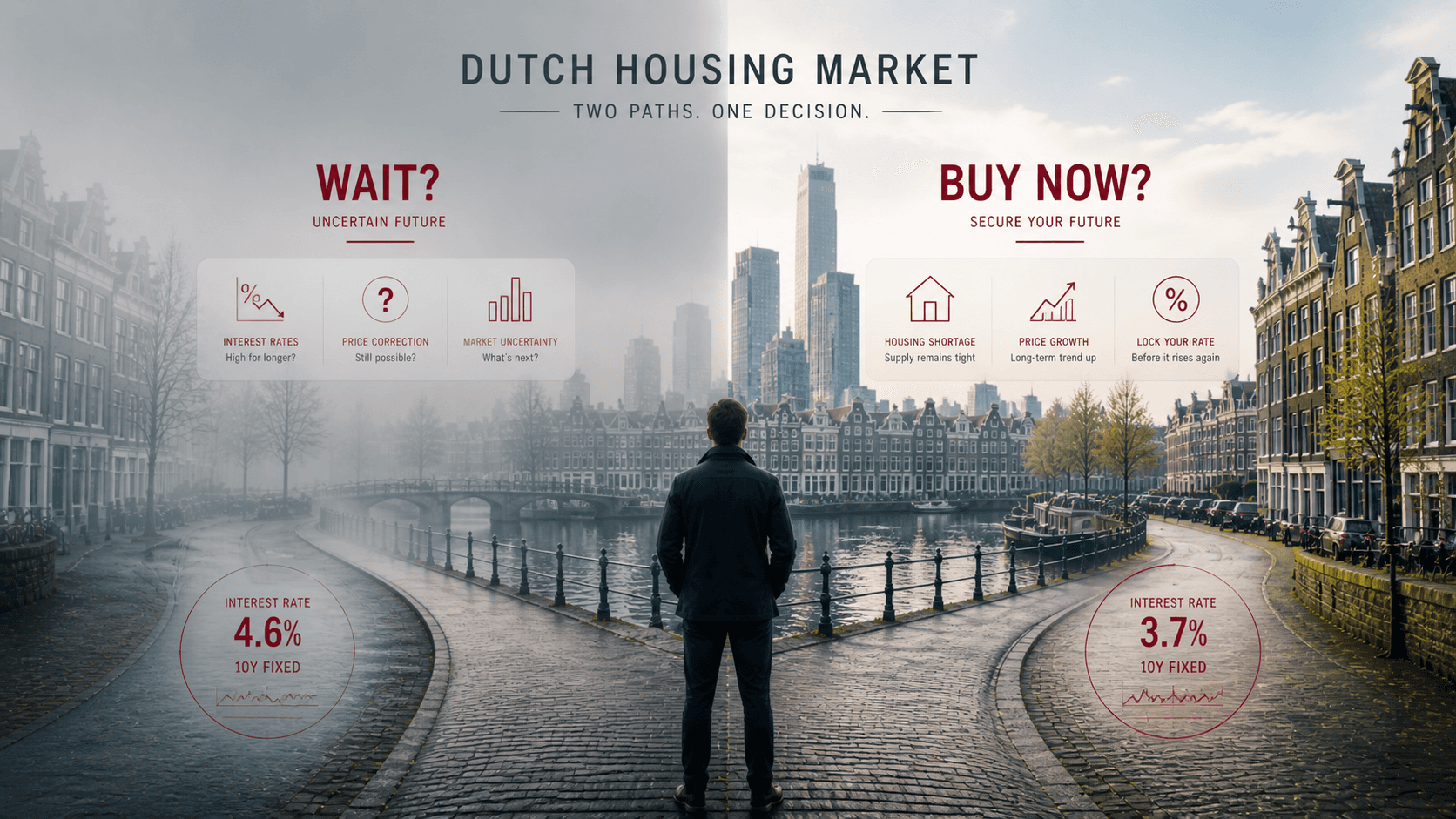
As of early 2026, 10-year fixed mortgage rates in the Netherlands are broadly in the 3.7%–4.2% range, depending on lender, loan-to-value, and property characteristics.
Importantly, these rates have not moved as much as many expected.
While the ECB has cut its deposit rate, Dutch mortgage rates are more closely linked to long-term bond yields — particularly German government bonds. Those yields have remained relatively elevated, limiting the pass-through of ECB rate cuts to mortgage pricing.
What happens next?
Over the next 6 months, three realistic scenarios:
Rates fall to ~3.4–3.5%
Requires a meaningful macro slowdown. Would increase borrowing capacity by roughly €15,000–20,000 for a median-income household — enough to re-activate marginal buyers.Rates remain in the 3.7–4.2% range (base case)
Affordability remains broadly unchanged. The current ceiling for buyers stays in place.Rates rise to 4.3–4.5%
Possible if bond yields increase. This would further reduce borrowing capacity and tighten the market for first-time buyers.
What this means for buyers
Do not base your decision on the assumption that rates will fall significantly in the short term.
Buy if the numbers work at today’s rates — not on the expectation of refinancing in 6 months.
Not All Buyers Are Affected Equally
One of the most important — and often overlooked — shifts in 2026 is this:
The constraint is not uniform across buyers.
First-time buyers are highly sensitive to mortgage rates and affordability ceilings.
Equity-rich buyers (those selling an existing home) are far less dependent on borrowing capacity.
This means the market is no longer driven by one unified demand curve.
It is driven by who can still participate — and who is priced out.
Where the Market Actually Differs
Location: G4 Cities vs the Rest
The four major cities — Amsterdam, Rotterdam, Utrecht, The Hague — are currently under different pressure than smaller cities and peripheral regions.
In Amsterdam, price growth has been noticeably weaker (around +5% in 2025), and time on market has increased significantly. Rotterdam has shown periods of near-zero growth.
A key factor is supply: a large number of former rental apartments have been sold to owner-occupiers as landlords exit under new regulations and taxation.
This has added supply precisely in segments where prices were already stretched — particularly urban apartments.
Outside the G4, the picture is different.
Regions such as Groningen and parts of Zeeland have shown stronger growth (in some cases well above the national average), reflecting lower price bases and different demand dynamics. Remote work and relative affordability may be contributing to this shift — but the exact drivers vary by region.
What it means
G4 cities: more choice, less urgency, more negotiation
Peripheral regions: stronger price momentum, but less flexibility and fewer alternatives
Apartments vs Houses: Where Supply Has Changed
This is one of the most important distinctions in the current market.
Roughly 34,000 former rental homes have been sold over the past year — the majority of them apartments in major cities.
This has created:
more listings
longer time on market
increased willingness to negotiate
Houses, by contrast, have not experienced the same supply increase.
Detached and semi-detached homes — especially outside city centres — remain supply-constrained and competitive.
Energy label now matters more
Homes with poor energy labels (D–G):
stay on the market longer
attract fewer bids
often require price negotiation
Homes with A–C labels:
sell faster
maintain stronger pricing
This is driven both by buyer preference and financing conditions, as energy efficiency increasingly affects total cost of ownership.
Price Segments: Where Competition Is Strong — and Where It Isn't
Under €400,000
Still the most competitive segment
Supply is tight
Overbidding remains common
Buyers have limited negotiating power
€400,000–€500,000
More balanced
Overbidding still present, but reduced
NHG eligibility (up to €470,000 in 2026) plays a major role
Above €500,000
Slower segment
Longer time on market
Less overbidding
More room for negotiation
Affordability constraints are strongest here for leverage-dependent buyers.
What Is Not Obvious
National averages are misleading
A national figure like +2.1% price growth hides a wide divergence:
some regions growing strongly
some segments flat or stagnating
The market is no longer moving as one.
Lower overbidding does not equal falling prices
Overbidding has dropped from double digits to around +3–4%.
This reflects a return to more rational pricing, not necessarily a price decline.
Sellers are setting more realistic asking prices — and buyers are paying closer to them.
The supply increase may not be permanent
Part of the recent increase in supply is linked to regulatory changes and expiring rental contracts.
However, it is uncertain how quickly this supply will normalize.
Landlord decisions continue to depend on taxation (Box 3), regulation, and expected returns — not just contract timelines.
Practical Takeaways: Buying in 2026
Move now if:
You are buying a house in a supply-constrained segment
You are in the sub-€400k or NHG-supported range
You need stability and are not speculating on short-term price movements
Take your time if:
You are buying an apartment in a major city (especially >€450k)
You want to negotiate
You are flexible on timing
This is where buyer leverage is currently strongest.
Where you have the most negotiating power:
apartments in G4 cities
higher price segments
homes with poor energy labels
Do not rely on rate timing
The most likely scenario is stable mortgage rates in the short term.
Waiting for a significant drop may not improve your position — but it will delay your entry.
What to Watch Next (If You're Not Buying Today)
If you are considering waiting, these are the indicators that will matter most over the next 6 months:
Mortgage rates (weekly)
This is the single most important constraint on affordability. Even small changes (0.3–0.5%) can materially shift your buying power.Buyer intent (Rabobank / Funda activity)
This typically moves before prices. A recovery here is the earliest signal that demand is returning.Overbidding levels (NVM data)
Not a leading indicator, but a very reliable real-time signal of competition. If overbidding continues to compress, price growth will likely stay muted.Uitponding (landlord sell-offs)
This determines how much additional supply enters the apartment market — especially in major cities. A slowdown here would tighten supply again.New-build sales vs. listings
If developers start cutting prices to move inventory, it will put pressure on comparable existing homes.Unemployment and confidence (CBS)
Even small increases in unemployment tend to reduce buyer activity disproportionately.
Final Thought
The key shift in 2026 is not a collapse in demand.
It is a change in how the market functions.
Price growth is no longer automatic.
It depends on segment, location, and buyer profile.
_______________________________
This article is part of the Expat Gate research series on the Dutch property market. Expat Gate NL is the Netherlands branch of Expat Gate Global — an independent research and advisory firm helping investors make data-driven property decisions across international markets.
